
Sources & Organizations
Specific Information
.
.
2014 California Proposition 47 -Wikipedia
Proposition 47, also known by its ballot title Criminal Sentences. Misdemeanor Penalties. Initiative Statute, was a referendum passed by voters in the state of California on November 4, 2014. The measure was also referred to by its supporters as the Safe Neighborhoods and Schools Act.[2] It recategorized some nonviolent offenses as misdemeanors, rather than felonies, as they had previously been categorized.
The crimes affected were:
Back to Prop47 – LA Public Defender
Proposition 47 (Prop 47) was a ballot measure passed by California voters on November 5, 2014. The law made some non-violent property crimes, where the value does not exceed $950, into misdemeanors. It also made some simple drug possession offenses into misdemeanors. It also provides that past convictions for these charges may be reduced to a misdemeanor by a court. Under Prop 47, you may qualify for a reduction from a felony to a misdemeanor for some of the following offenses:
Individuals eligible for resentencing/ reclassification under Proposition 47 must file their applications/petitions by November 4, 2022. If you think you may qualify for Prop 47 legal relief, please complete our intake form by clicking here, or you may also visit one of our Public Defender offices, here.
California Proposition 47, Reduced Penalties for Some Crimes Initiative (2014) – Ballotpedia was on the ballot as an initiated state statute in California on November 4, 2014. It was approved.
AB-109 Criminal justice alignment – CA Legislative Information
PUBLIC SAFETY REALIGNMENT (AB 109) – SUMMARY OF KEY PROVISIONS
AB 109 Realignment in California
17 Most Notable AB 109 Pros and Cons
The goal of AB 109 is to divert people who are convicted of felonies that are not defined as serious to local country jails. That reserves more space for those convicted of serious felonies at state prisons, such as sexually-based offenses or violent crimes. The purpose of this realignment was to reduce the issues of overcrowding that were occurring at the state prison level.
The bill took effect on October 1, 2011. Since its initial creation, AB 109 has been altered by AB 116, AB 117, and AB 118.
CA ASSEMBLY BILL 109 (AB 109) -Placer County
In April 2011, the California Legislature and Governor Brown passed Assembly Bill 109 (AB 109), which shifted responsibility for certain populations of offenders from the state to the counties. Assembly Bill 109 establishes the California Public Safety Realignment Act of 2011 which allows for current non-violent, non-serious, and non-high risk sex offenders, after they are released from California State prison, to be supervised at the local County level. Instead of reporting to state parole officers, these offenders report to local county probation officers.
National Action Plans on Antimicrobial Resistance – RA
.
California Proposition 20 was a proposed initiated state statute on the ballot in the 2020 California elections. This initiative would have added more crimes to the list of non-violent felonies for which early parole is restricted, and would have required DNA collection for certain misdemeanors.[1]
According to its ballot summary, Proposition 20 would have
Proposition 20 was decisively rejected by 62% of Californians, a margin of 24 percentage points. Observers partly attributed its failure to the George Floyd protests bringing negative attention to punitive criminal justice policies
Proposition 20 | Official Voter Information Guide | California Secretary of State
A YES vote on this measure means: People who commit certain theft-related crimes (such as repeat shoplifting) could receive increased penalties (such as longer jail terms). Additional factors would be considered for the state’s process for releasing certain inmates from prison early. Law enforcement would be required to collect DNA samples from adults convicted of certain misdemeanors.
A NO vote on this measure means: Penalties for people who commit certain theft-related crimes would not be increased. There would be no change to the state’s process for releasing certain inmates from prison early. Law enforcement would continue to be required to collect DNA samples from adults only if they are arrested for a felony or required to register as sex offenders or arsonists.
2020-10-28 Reimagining Criminal Justice: The Lasting Effects of the 3 Strikes
Law and Proposition 20 My uncle has spent 25 years in prison because of California’s Three Strike’s Law. Advocates of Proposition 20 want keep him there longer.
Proposition 20: Crackdown on crime The Basics
California
2020-10-16 Prop. 20 sparks debate over effects of criminal justice reform in California
Now a group of prosecutors and law enforcement leaders has placed Proposition 20 on the November statewide ballot, which would expand the list of felonies for which the convicted are ineligible for early parole; increase penalties for repeat shoplifters; and collect DNA samples from adults convicted of some misdemeanors.
Proponents argue that it is needed to fix flaws in past measures that they say are putting the public’s safety at risk, including the early release of potentially violent criminals. But opponents of the measure, who include civil rights leaders, Gov. Gavin Newsom and former Gov. Jerry Brown, say it wrongly rolls back necessary criminal justice reforms as crime has declined in recent years.
2020-08-26 No on Proposition 20, a heavy-handed reaction to justice reforms
Over the last decade, California has undertaken significant criminal justice reforms aimed at reducing the state’s prison population.
In 2011, the year the U.S. Supreme Court ordered California to reduce its prison population, the Legislature approved Assembly Bill 109, which shifted greater responsibility for non-violent, non-serious and non-sexual offenders from the state level to the county level. This was followed by Proposition 47 in 2014, which reduced a handful of low-level drug and property crimes from felonies to misdemeanors, and Proposition 57 in 2016, which incentivizes prisoners to participate in rehabilitative programming.
Each step of the way, police unions opposed reforms, arguing they would make California less safe. The evidence of this in aggregate is mixed at best, with California experiencing historically low levels of crime.
Researchers in 2016 flagged increases in some property crimes, particularly car theft, following the passage of AB109 as potentially linked to the law. The impact of Prop. 47 on crime rates has been contested, with researchers at the University of California, Irvine determining it had no impact on crime rates, while the Public Policy Institute of California determined it may have contributed to an increase in larceny.
The Bilderberg meeting (also known as the Bilderberg Group) is an annual conference established in 1954 to foster dialogue between Europe and North America. The group’s agenda, originally to prevent another world war, is now defined as bolstering a consensus around free market Western capitalism and its interests around the globe. Participants include political leaders, experts from industry, finance, academia, and the media, numbering between 120 and 150. Attendees are entitled to use information gained at meetings, but not attribute it to a named speaker. This is to encourage candid debate, while maintaining privacy – a provision that has fed conspiracy theories from both left and right.
Proponents of Bilderberg conspiracy theories in the United States include individuals and groups such as the John Birch Society,[40][44] political activist Phyllis Schlafly,[44] writer Jim Tucker,[45] political activist Lyndon LaRouche,[46] conspiracy theorist Alex Jones,[2][47][48] and politician Jesse Ventura, who made the Bilderberg group a topic of a 2009 episode of his TruTV series Conspiracy Theory with Jesse Ventura.[49] Non-American proponents include Lithuanian writer Daniel Estulin[50] and British politician Nigel Farage.[51]
Concerns about lobbying have arisen.[52][53] Ian Richardson sees Bilderberg as the transnational power elite, “an integral, and to some extent critical, part of the existing system of global governance“, that is “not acting in the interests of the whole”.[54] An article in The Guardian in June 2017 criticized the world view expressed in an agenda published by the Bilderberg group.[55]
Partly because of its working methods to ensure strict privacy and secrecy,[35] the Bilderberg Group has been criticised for its lack of transparency and accountability.[36] The undisclosed nature of the proceedings has given rise to several conspiracy theories,[37][17][38] which have been popular at both extremes of the political spectrum, although there is disagreement about the exact nature of the group’s intentions. Some on the left accuse the Bilderberg group of conspiring to impose capitalist domination,[39] while some on the right have accused the group of conspiring to impose a world government and planned economy.[40]
19 Shocking Facts And Theories About The Bilderberg Group
The first Bilderberg meeting was held during 1954. The organization was founded with the intent to create powerful connections between European countries and North Americans. The meeting is a secretive, informal discussion about global trends with open communication between the elite members of the world who have massive influence in world affairs.
No statements of any kind are allowed to be made to the press regarding the proceedings or what is talked about at the meeting. There are no meeting minutes taken and no reports of the discussions or official statement about the discussions is produced or made. Anything learned at the meeting can be freely used by any of the members; however, no one is permitted to talk about it.
More than 400 heavily armed guards are there protect the attendees. The event space is hardened with physical barricades and high levels of security. It is this level of high security combined with the extreme secrecy, which makes the conspiracy theorists go wild with speculation about what they actually do at the Bilderberg meetings.
Only those who are invited are permitted to attend the meeting. Everyone invited sees a major career boost after attending a Bilderberg meeting. Bill Clinton attended while he was the Governor of Arkansas and within a year he was President of the United States. Tony Blair became Prime Minister of the UK, four years after going to his first Bilderberg meeting.
The co-founders of the Bilderberg Group were two historical figures with checkered backgrounds. They were Prince Bernhard from the Netherlands and Józef Retinger who was a political advisor, originally from Poland, who worked with the Vatican.
The Bilderberg Group publishes on its website a simple list of the items that will be discussed at an upcoming meeting, without giving any further details. The Bilderberg Group also publishes a list of the attendees. Members of the Bilderberger Group are some of the richest, most powerful, and most famous people in the world. The Bilderberg Group is a conspiracy theorist’s dream scenario. Since no one except the attendees of the Bilderberg meetings knows what is said or done, anything imaginable might be going on.
Paul Warburg founded the Council on Foreign Relations during 1921 and David Rockefeller founded the Trilateral Commission. These organizations are similar to the Bilderberg Group. David Rockefeller is a member of all three. Just like the Bilderberg Group, the extent and reach of the powerful members of the Council on Foreign Relations and the Trilateral Commission have influenced the globe for decades. It makes very little difference who is the President in the White House because these power brokers are the ones really in charge. In most cases, without their approval and support, there is no way to get elected.
The common goal of the Council on Foreign Relations and the Bilderberg Group is the creation of a one world government with a central global financial system. The two groups work together. The Council on Foreign Relations works on the U.S. side with the Bilderberg Group working on the European side. In order to create a new world economy, the Bilderbergers believe that they need to destroy the separate national ones. They plan to achieve this by causing either a long depression that generates decades of decline and poverty or they plan to use sudden intense economic shocks. These shocks will be similar to the 2006 American housing market collapse. This will allow them to re-set national economies into a new alignment with reduced national sovereignty and increased efficiency.
The Bilderberg Group understands that the destruction of the U.S. dollar is necessary in order to replace it with a world currency. The bankers have been eroding the value of the U.S. dollar for a very long time. A dollar is worth less than 2% of what a U.S. dollar was worth one hundred years ago. U.S. government officials have been participants in this process, making a mountain of debt that can never be paid back.
The enormous growth in the global population and its continued increase is not sustainable over the long term. One way the Bilderberg Group can reduce the human population is by causing pandemics. Biological agents can be intentionally used to cause a major outbreak of illness, which kills millions. Many of the super elite have so little concern for the masses that they consider this the same as culling a herd of animals.
Media is controlled very heavily by very few companies. Governments actively participate in the censorship of media, as well as promote disinformation if it serves their purpose. These are propaganda campaigns that are carefully designed to create public opinion in order to protect corporate power.
The Bilderberg Group starts its process to build its empire by the creation of Trade Zones and Trade Agreement that benefits the multinational corporations. They have little interest in any improving the economic levels for the lower classes as long as there are enough of them are able to buy their products. The jobs all move to the places with the lowest wages, no benefits, and bad working conditions. This allows the multinational corporations to maximize profits.
Action for a Change: A Student’s Manual for Public Interest Organizing – Ralph Nader In this action-oriented manual, Ralph Nader answers the plea of college students: What can we do about pollution and consumer injustice? How can students and other citizens work to get things done in their communities and states? A step by step guide is offered for forming Public Interest Research Groups (PIRG) like Nader’s in Washington, D. C., and the Nader-inspired PIRG’s in Minnesota and Oregon. Attorney Donald Ross shows in detail how to initiate public interest and research groups, how to marshal talent, how to finance the group, and how to put it to work. The PIRG approach is advocated to bring about “initiatory democracy,” a full-time citizenry, aware, informed, and constantly acting upon social, economic, and political institutions in the public interest. (BL)
Animal Envy: A Fable Ralph Nader’s newest work of the imagination, Animal Envy, is a fable about the kinds of intelligences that are all around us in other animals. What would animals tell us—about themselves, about us—if there were a common language among all animal species? A bracingly simple idea, one that has been used before in books like George Orwell’s Animal Farm and E. B. White’s Charlotte’s Web among others, but never like this.
Breaking Through Power – Ralph Nader In Breaking Through Power, Nader draws from a lifetime waging—and often winning—David vs. Goliath battles against big corporations and the United States government. This is classic Ralph Nader, a crystallization of the core political beliefs and commitments that have driven his lifetime of advocacy for greater democracy.
Unsafe at Any Speed: The Designed-In Dangers of The American Automobile – Ralph Nader We picked the 100 best and most influential written in English since 1923, the beginning ofTIME … magazine” Ralph Nader’s book Unsafe at Any Speed is number 21 on the list! Unsafe at Any Speed was published in 1965. It is Ralph’s first book. And it was the book that launched the modern consumer movement.
Unstoppable: THE EMERGING LEFT-RIGHT ALLIANCE TO DISMANTLE THE CORPORATE STATE – Ralph Nader We are at one of the most pivotal moments in our country’s political history: Americans are more disillusioned with their political leaders than ever before and large majorities of citizens tell pollsters that big corporations have too much political power. The ever-tightening influence of big business on the mainstream media, elections and our local, state, and federal governments, have caused many Americans to believe they have no political voice.
.
Breaking Through Power – Ralph Nader In Breaking Through Power, Nader draws from a lifetime waging—and often winning—David vs. Goliath battles against big corporations and the United States government. This is classic Ralph Nader, a crystallization of the core political beliefs and commitments that have driven his lifetime of advocacy for greater democracy.
Day the Rats Vetoed Congress (The) – Ralph Nader & Mr. Fish In this heavily illustrated fable written by the influential public advocate, rats invade Congress — and the citizens revolt!
Fake President: Decoding Trump’s Gaslighting, Corruption, and General Bullsh*t – Ralph Nader & Mark Green Donald Trump was lawfully selected as the US president…but is still a “fake” president because he simply lacks the integrity, empathy, intelligence, and stability to perform the duties of the office as the Constitution intended. “If you spend so much time golfing, tweeting, seething, and covering up your corruption,” write Green and Nader, “it’s understandable that a POTUS doesn’t get around to appointing one-third of all agency inspector generals…Might as well expect a surgeon to be an opera singer.”
Return To Sender: Unanswered Letters to the President, 2001 – 2015 – Ralph Nader In letters addressed to Presidents George Bush and Barack Obama, Ralph Nader provides incisive critiques of more than a decade of American policy decision and indecision. Each letter offers frank advice and shines light on government mishaps and missed opportunities for progress. With his signature dry wit, Nader holds these Presidents to their campaign promises. He also boldly points to the ignoble and sometimes heinous decisions made in pursuit of party platforms and misguided ideals. Covering a range of still-current topics–including the Iraq war, torture, the Crimean annexation, the minimum wage, worker’s health legislation, and corporatism–these letters were wholesale ignored on receipt. Here they are reproduced to refute that fate in the spirit of true and healthy democracy.
Stealing Our Democracy: How the Political Assassination of a Governor Threatens Our Nation by Don Siegelman Don Siegelman was the 51st Governor of Alabama, serving from 1999 to 2003. He is the only politician in Alabama history to hold all of the state’s top constitutional offices: governor, lieutenant governor, attorney general, and secretary of state. He was the longest-running Democrat in the Southeast. He was convicted in 2006 of federal bribery charges, in what many think was a wrongful conviction brought about by Republican politicians. “There’s no deterrent. You steal an election and you get away with it. And even if you’re caught, nobody goes to jail. I mean this happens again and again in this country. It’s like, ‘Oh you know, it’s just politics as usual.’”
“The heart of my story: It’s not about me. It’s about saving our democracy. And exposing what has been going on in our court system. There’s a reason why the majority of people behind bars are young men and women of color.” Well now they’re releasing thousands of inmates, who are not a threat to public safety, which raises the question why in the world are they in there in the first place?”
The Dangerous Case of Donald Trump: 27 Psychiatrists and Mental Health Experts Assess a President by Bandy X. Lee Since the start of Donald Trump’s presidential run, one question has quietly but urgently permeated the observations of concerned citizens: What is wrong with him? Constrained by the American Psychiatric Association’s “Goldwater rule,” which inhibits mental health professionals from diagnosing public figures they have not personally examined, many of those qualified to answer this question have shied away from discussing the issue at all. The public has thus been left to wonder whether he is mad, bad, or both. In THE DANGEROUS CASE OF DONALD TRUMP, twenty-seven psychiatrists, psychologists, and other mental health experts argue that, in Mr. Trump’s case, their moral and civic “duty to warn” America supersedes professional neutrality. They then explore Trump’s symptoms and potentially relevant diagnoses to find a complex, if also dangerously mad, man.
To the Ramparts: How Bush and Obama Paved the Way for the Trump Presidency, and Why It Isn’t Too Late to Reverse Course – Ralph Nader The great elder statesman of consumer rights shows how previous administrations allowed unchecked corporate power to lead us to the criminality of Trump.
Unstoppable: THE EMERGING LEFT-RIGHT ALLIANCE TO DISMANTLE THE CORPORATE STATE – Ralph Nader We are at one of the most pivotal moments in our country’s political history: Americans are more disillusioned with their political leaders than ever before and large majorities of citizens tell pollsters that big corporations have too much political power. The ever-tightening influence of big business on the mainstream media, elections and our local, state, and federal governments, have caused many Americans to believe they have no political voice.
Wrecking America: How Trump’s Lawbreaking and Lies Betray All – Ralph Nader Timed for the Fall Election, coauthors Mark Green and Ralph Nader describe the presidential race as Fascism for some vs. Democracy for all. The book focuses on Lawbreaking, Covid-19, Race in chapters that assess his disinformation topic-by-topic. Authors look ahead to what happens if Trump’s re-selected by Electoral College or loses in a realigning landslide.…
.
Written by 9/11 Truth Outreach Staff

As the events at the Pentagon unfolded on 9/11, a series of photographs were taken by Daryl Donley that recorded the initial moments immediately after the plane impact into the western side of the Pentagon. After taking the photographs he dropped his film off for developing and later called a friend at Gannett (a major newspaper publisher) and informed her of his story and that he had taken photos.
Gannett bought Donley’s photos and made them available to papers across the country. “I never saw them in print, so I have no idea who used them,” Donley said. In April 2002, he learned from a reporter that one of his photos was published in Life 2002 Album: The Year in Pictures (which contains pictures from 2001). Additionally, others photographs of his were published in Paris Match and in the Daily Mail in London, and the Library of Congress has several of his pictures in its permanent collection. No other photos are believed to have been taken within the same time frame as Donley’s.
In the 9/11 literature and websites, Donley’s photographs have appeared many times without attribution and without context. For example, in some places his last photos in chronological order are said to be the first photos. To provide the context and a more complete record, he created a website to mark the 10th Anniversary of the September 11th attack on the Pentagon. At that time, most of the photographs had not been available to the public. Reduced quality images are included in this article to provide a catalogue of the photos. Higher resolution photographs on Donley’s 911pentagonphotos.com website can be seen by clicking on “Gallery” and then “September 11th Gallery.”
The purpose of this article is to place those initial photographs in context using the words of the photographer himself. Hopefully this will help provide a basis for a more accurate discussion of the events at the Pentagon. The following text is taken largely from Donley’s Information/About Us section.
Daryl Donley’s editorial, production, and documentary photography has appeared in The New York Times, The Village Voice, The Washington Post, national and international magazines, and books, including Life’s 2002 edition of The Year in Pictures covering the events of September 11, 2001. The Discovery Channel featured Donley’s photographs in the documentary, Attack on the Pentagon. Additionally, Donley’s September 11th photographs have been exhibited by the Smithsonian Institution and appear in the permanent collections of the Newseum and the Library of Congress. One of his photos is on display at the National September 11 Memorial & Museum in New York City.
“I had been driving to work for about 45 minutes in unusually bad bumper to bumper traffic. While I was stopped in traffic, in front of the Pentagon, I heard a loud sound get very loud extremely fast. I ducked down in my car as quickly as I could. I followed the sound as it traveled over me. I looked up to see the entire plane next to my car, through my passenger window a short distance away. I watched the plane fly into the Pentagon. I heard the crunching sound of the plane disintegrating as it slammed into the building at ground level. I screamed as loudly as I possibly could. The plane disappeared into the building as a massive fireball erupted, engulfing one side of the Pentagon; I felt the heat.
I got out of my car. Traffic was completely stopped at that time. Military Police on the north and south end of the roadway in front of the Pentagon were holding traffic in place. I paced back and forth across the road a few times in complete disbelief. I saw one man in the stopped traffic calmly speaking on his cell phone standing next to his car. Another woman near him was screaming hysterically out of control in her vehicle.
As I was pacing, I realized I had all my camera equipment in my car since I was planning on photographing an event later in the day. Initially I dismissed picking up my camera in the midst of something so traumatic and raw but ultimately decided what was happening in front of me needed to be documented.
I went to my car. Although my hands were shaking like leaves in a stiff wind, I managed to load film in my camera and, after a few failed attempts, successfully loaded a new battery. I was photographing within a couple of minutes of the plane crash. As a lifelong photographer, once I engaged with the camera, my instincts took over and I asked myself, ‘what will tell the story of this instant?’ I continued until the Military Police decided to clear the road.
Even then, as I drove away, I continued to photograph in the very slow stop and go traffic. It took me about another hour and a half until I crossed Roosevelt Bridge and was able to park and get out of my car.”
In retrospect, I believe these photographs did capture the moment and they succeeded in telling the story of the initial moments of horror after a large airplane crashed into the Pentagon.”
The following 25 images record the events from about two minutes after the plane impact for some unspecified period of time. Larger images of the following photographs can be viewed in the Gallery section of 911pentagonphotos.com.
Below, intermixed with Donley’s photographs are three satellite images of the Pentagon. These have additional lines that identify where the first 21 photos were taken and the approximate line of sight. Because Donley had all of his camera equipment with him in his car, he was able to use both zoom and wide angle lenses. All the photos were taken from the vicinity of his vehicle.
The most iconic image is that of a fireball that was captured in image 14. Donley recounts that prior to taking the photograph, he was looking through the viewfinder of his camera when he saw the fireball beginning to erupt. He said, “Through the viewfinder, I could see a circle in front of me.” He recounted thinking that there would be four “chunks” of time to click the photo. He waited for the right moment. He waited until the fireball expanded and then took the photograph. He clicked on what he referred to as “the third chunk of time.” He said, “Unless you were looking through the viewfinder when it began, there would be no time to bring the camera up to photograph it.” He said, “The original fireball following the impact was 3 to 4 times as high as the Pentagon. This fireball was about 40 feet wide based on its size vs the size of the Pentagon. It was definitely an explosion.”
The second most iconic image is photograph #23 which was taken from his car’s rear-view mirror. According to Donley, “To me, this photograph tells the story of 9/11 like no other… a lost person walking, disoriented and confused with the Pentagon burning in the background. This was ‘America’ on 9/11.” Supporting the iconic status of this photograph, this is Donley’s only image that is on display at the 9/11 Museum.
Satelite photo of Pentagon on September 12, 2001, showing approximate locations where photos 1 to 8 were taken. (Source: The Pentagon – September 12, 2001 – IKONOS 1-meter (aftermath image)
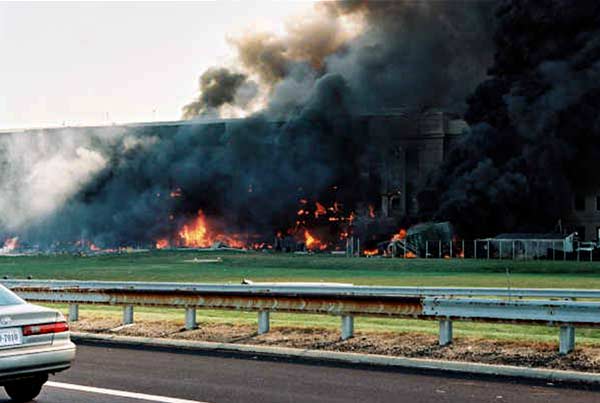 Daryl Donley Gallery — Image 1 (Taken one or two car lengths in front of his car, near intersection with on-ramp)
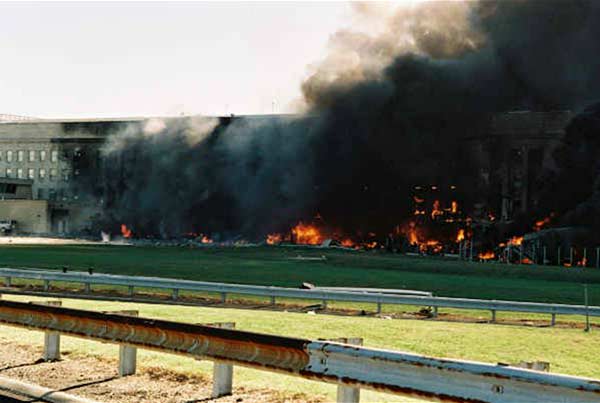 Daryl Donley Gallery — Image 2 (Wider view from about same location as Image 1)
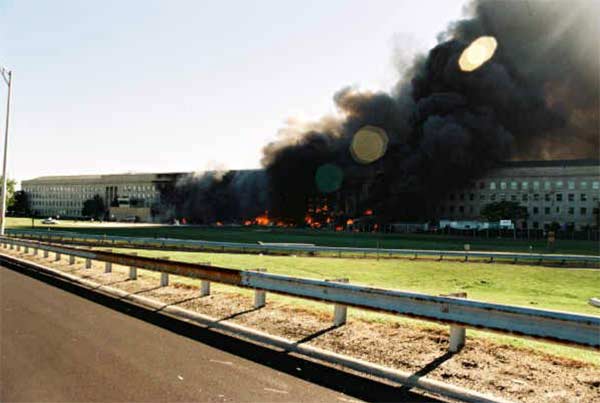 Daryl Donley Gallery — Image 3 (Wider angle view of image 2)
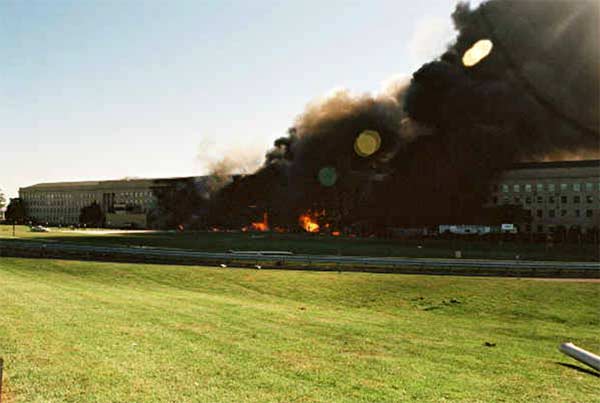 Daryl Donley Gallery — Image 4 (Same as image 2 taken from along the guardrail)
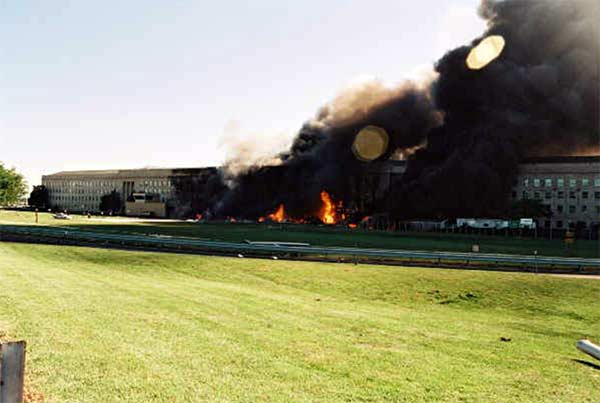 Daryl Donley Gallery — Image 5 (Similar to Image 4)
 Daryl Donley Gallery — Image 6 (Zoom into impact area)
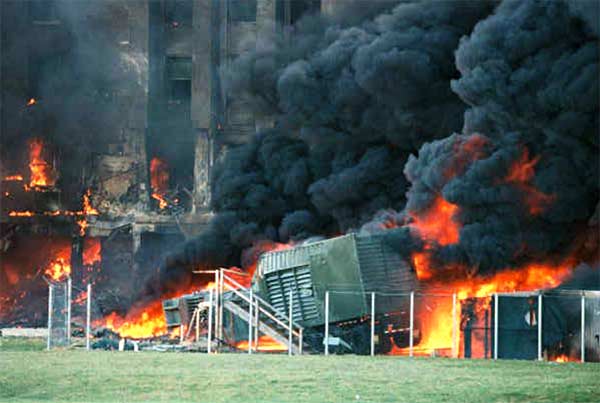 Daryl Donley Gallery — Image 7 (Zoom into diesel generator)
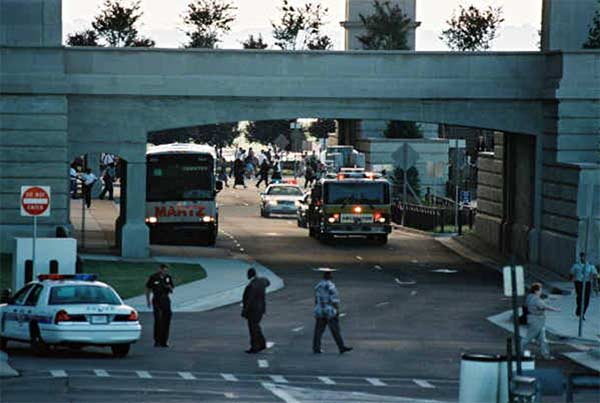 Daryl Donley Gallery — Image 8 (Arrival of emergency vehicles)
Approximate location where photos 9 to 17 were taken (Source: The Pentagon – September 12, 2001 – IKONOS 1-meter (aftermath image)
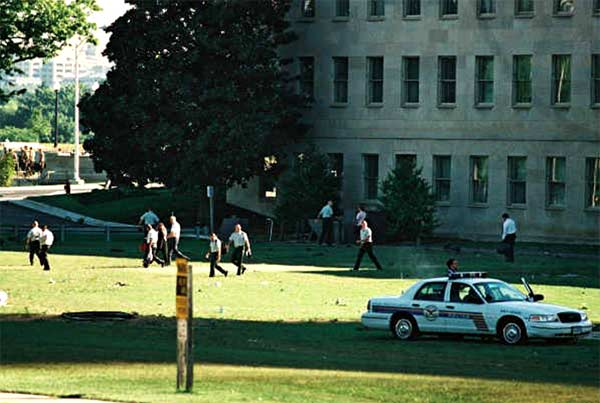 Daryl Donley Gallery — Image 9 (Zoom in of the north corner of the Pentagon)
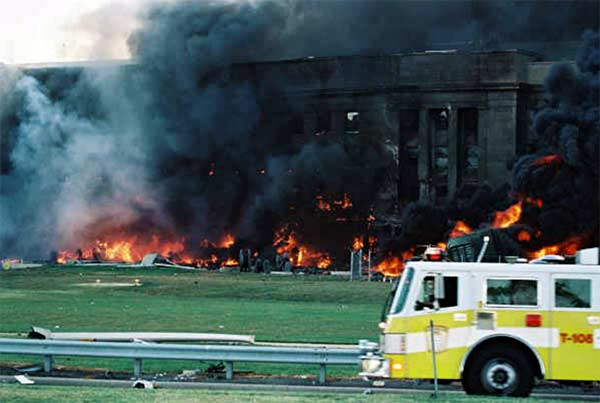 Daryl Donley Gallery — Image 10 (Arlington County Fire Department Truck 105 arrives at the Pentagon at 9:41 a.m. per Arlington County After-Action Report Appendix 1)
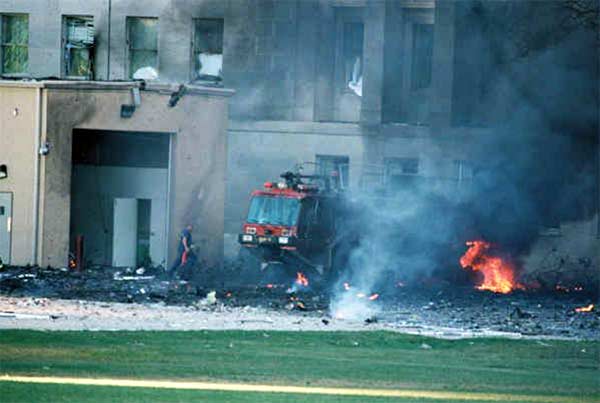 Daryl Donley Gallery — Image 11 (Heliport fire house and fire truck with undamaged windshield)
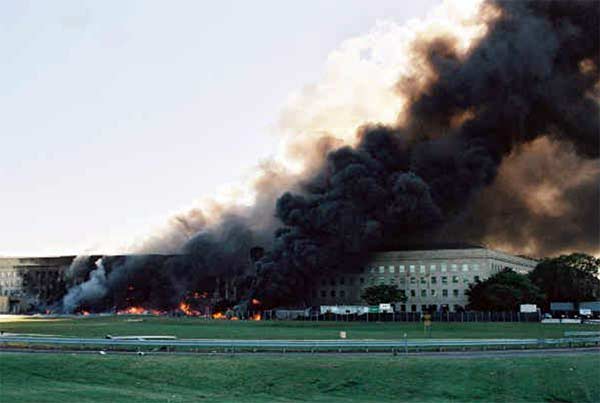 Daryl Donley Gallery — Image 12 (Wide angle view)
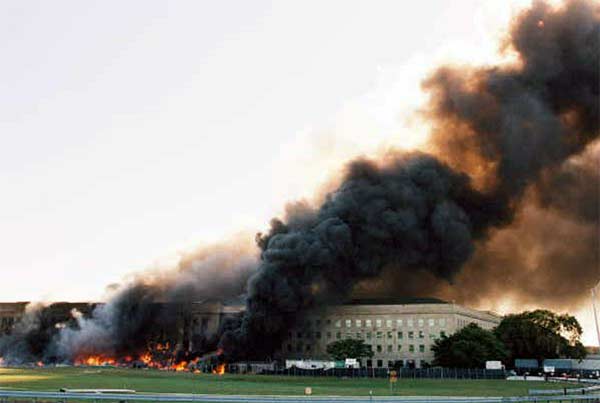 Daryl Donley Gallery — Image 13 (Wide angle view slightly to the right of Image 12)
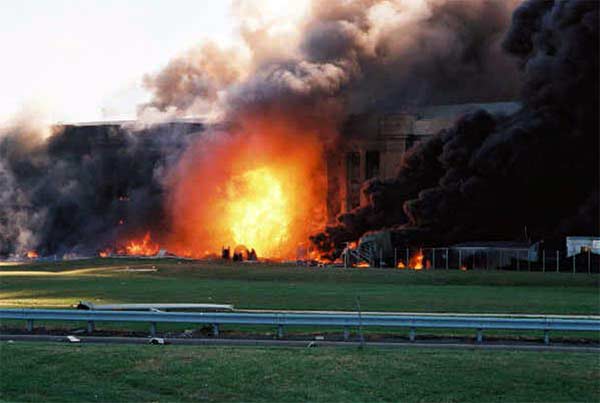 Daryl Donley Gallery — Image 14 (Bright Flash / Explosion in the vicinity of impact zone)
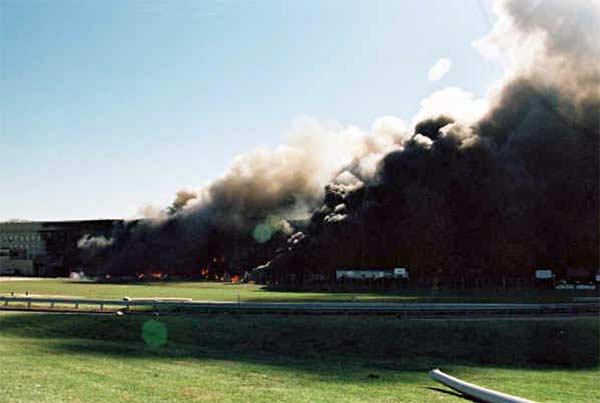 Daryl Donley Gallery — Image 15 (Wide angle view of impact zone after bright flash)
 Daryl Donley Gallery — Image 16 (Partial zoom-in of Image 15)
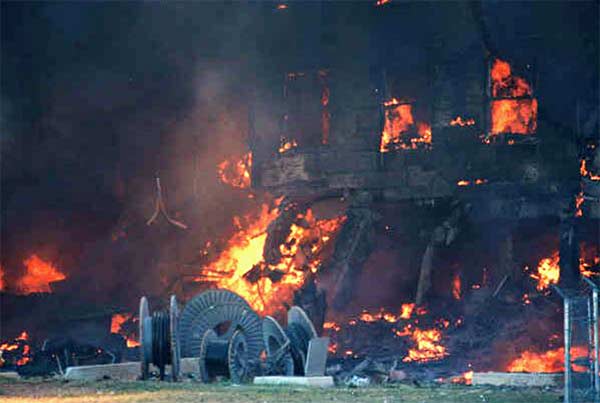 Daryl Donley Gallery — Image 17 (Zoom-in of impact zone after bright flash)
Approximate location where photos 18 to 21 were taken (Source: The Pentagon – September 12, 2001 – IKONOS 1-meter (aftermath image)
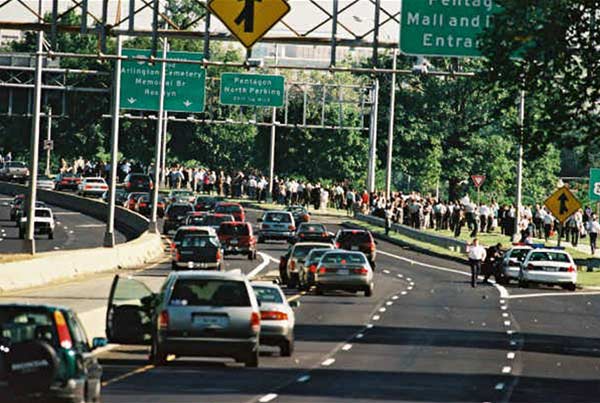 Daryl Donley Gallery — Image 18 (Stopped traffic on Washington Avenue)
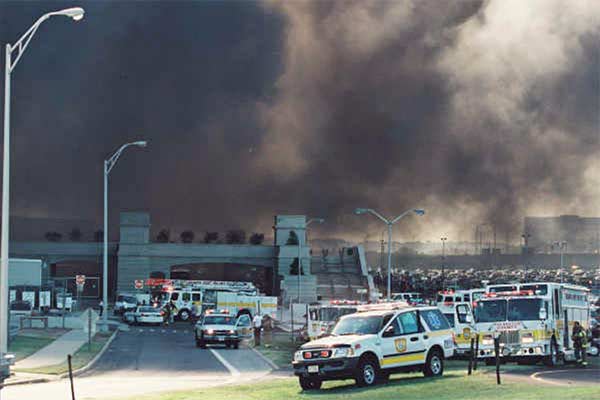 Daryl Donley Gallery — Image 19 (Looking down the road along south side of the Pentagon)
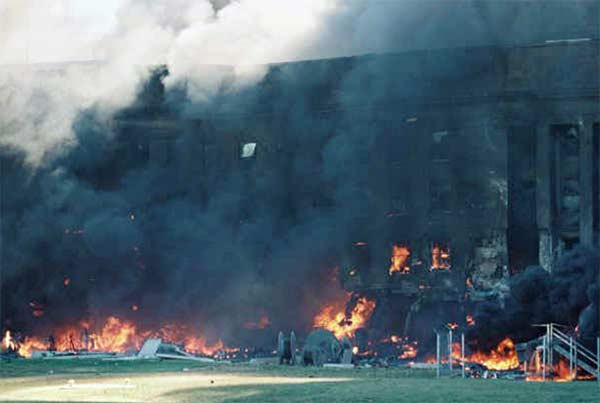 Daryl Donley Gallery — Image 20 (Zoom-in of impact zone)
 Daryl Donley Gallery — Image 21 (Traffic begins to move again. Note that there are chunks of debris and rocks from the Pentagon in the roadway.)
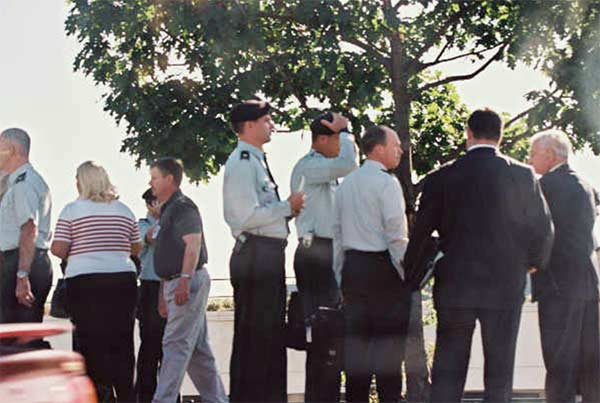 Daryl Donley Gallery — Image 22 (Bystanders)
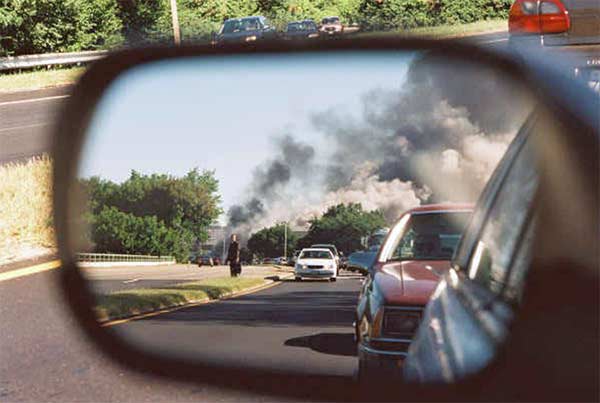 Daryl Donley Gallery — Image 23 (Pentagon in rear-view mirror)
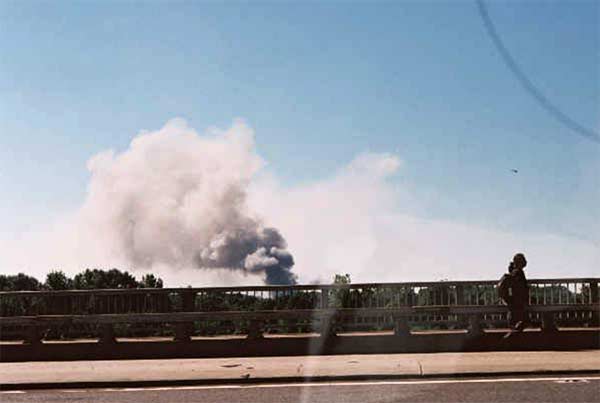 Daryl Donley Gallery — Image 24 (Pentagon in the Distance)
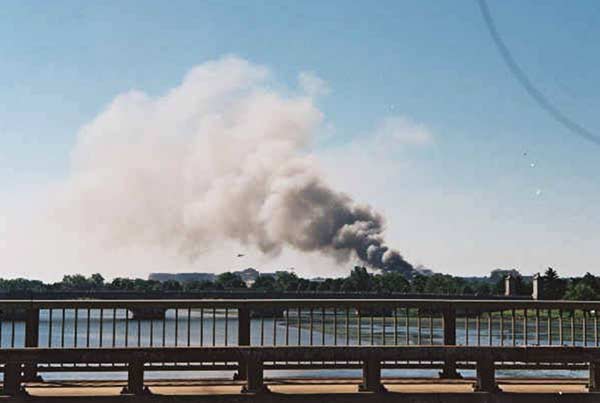 Daryl Donley Gallery — Image 25 (Pentagon in the Distance)

The 9/11 Truth Action Project does not have position about what happened at the Pentagon on 9/11
Written by 9/11 Truth Outreach Staff
As the events at the Pentagon unfolded on 9/11, a series of photographs were taken by Daryl Donley that recorded the initial moments immediately after the plane impact into the western side of the Pentagon. After taking the photographs, Donley dropped his film off for developing and later called a friend at Gannett (a major newspaper publisher) and informed her of his story and that he had taken photos. Gannett bought Donley’s photos and made them available to papers across the country. “I never saw them in print, so I have no idea who used them,” Donley said. In April…Read more…Saturday, August 20, 2016
Written by Barbara Honegger, M.S.
This paper presents compelling evidence that the central fact of the Pentagon attack on September 11, 2001, is the same as at the World Trade Center: inside-the-building explosives which no foreign terrorists could have had the access to plant, making the official narrative of what happened on 9/11 impossible. Physical evidence and eyewitness testimony converge to show that internal as well as external explosions went off just after 9:30 a.m., when the official narrative claims Flight 77 was still dozens of miles from Washington. The official narrative claims AA77 didn’t approach the building until 9:37:46, or almost 9:38….Read more…Thursday, May 08, 2014
Written by Pilots for 9/11 Truth (re-posted)
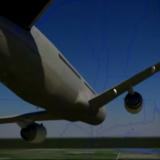
War Games, Simulated radar tracks, aircraft exceeding their max operating limits by more than 130-150 knots, inaccurate aircraft position reports, false aircraft target reports, aircraft converging — flying virtually in formation with — and then diverging from reported 9/11 aircraft, fighters launched in the wrong direction, aircraft seemingly still airborne after the alleged attack, poor communications, phones not working…. What happened in the skies on the morning of September 11, 2001? Why were our defenses ineffective? Pilots For 9/11 Truth analyze NORAD response, audio recordings as well as Radar data provided by…Read more…
.
The 9/11 Attack Government Conspiracy
.
| Absolutely Nothing i… on 911 Reward | |
 | C A on Alternative Media List |
| Wright, Ann Peace A… on Palestine and Israel | |
 | mekorganic on Great March of Return |
 | Johanna Casiddy on Great March of Return |
| Absolutely Nothing i… on 911 Reward | |
| C A on Alternative Media List |
| Wright, Ann Peace A… on Palestine and Israel | |
| mekorganic on Great March of Return |
| Johanna Casiddy on Great March of Return |

