DeSaulnier meditates on political journey (2013-09-12)

n his Concord office, Supervisor Mark DeSaulnier holds a photo of his father, Edward DeSaulnier, being sworn in as a Superior Court judge by former Massachusetts Gov. Foster Furcolo. (Dan Rosenstrauch/ Times);

(Editor’s Note: This article originally appeared April 18, 1999, in the Contra Costa Times.)

Contra Costa Supervisor Mark DeSaulnier is a Republican backed by Democrats who can’t decide in which party he would be most at home.

He’s an Irish Catholic who supports abortion rights, loves the symbolism of Mass, yet finds himself espousing Buddhist philosophy.

He’s a workaholic who knows his brutal schedule cost him his 15-year marriage, yet he doesn’t want to slow down.

Whether it’s personal or political, DeSaulnier, 48, seems to relish the struggle for the right answer. And now he has a new struggle. As one of the East Bay’s most influential leaders, DeSaulnier is examining his political future, looking beyond county government to Sacramento or Washington.

“I’m seriously considering it. The question is when,” he says. “If I’m successful at this level, then at some point I would like to go to a level where I’d have greater influence, where I could be involved with public policy that affects the state of California rather than just the eighth largest county in the state.”

But, like most major decisions DeSaulnier makes, this one will be ponderous.

Haunted by the memory of his father, a corrupt Massachusetts judge who chose quick personal gain over moral correctness, DeSaulnier cherishes slow and deliberate intellectual debate.

For him, life is a constant dialectic process, in which an idea is put on the table, then challenged to produce a synthesis of a new idea.

“I don’t think I’ll ever be an ideologue in politics or faith because I actually think you can be passionate about being someone who brings people together,” he explains.

“That’s what a politician should be doing, or any leader should be doing: Bringing people who have different opinions together. Then you come up with a solution that’s better for everybody. It’s not better for the ideologues, but it’s better for the larger community.”

Heavily influenced by the Jesuit priests who taught him when he was sent away to high school while his parents were divorcing, DeSaulnier says he believes strongly in the ultimate goodness of people and their ability to improve themselves.

“The idea that you’re human, that you have the potential to do better and redeem your mistakes,” he explains one night driving home from Sacramento, “is what makes us along with our intellect that being that has potential to go to a higher life within this physical existence.”

Then, suddenly, the tone of DeSaulnier’s voice changes. The internal struggle has produced a new revelation. “Maybe the Buddhists have it right,” he says. “It’s the journey.”

Consensus builder

DeSaulnier’s journey brought him to the East Bay two decades ago.

He transformed an old pawn shop in downtown Concord into one of the area’s most popular restaurants — a lunch-time hangout for some of the county’s leading power players.

He used an appointment to the city Planning Commission as a launching pad to the City Council, the county Board of Supervisors, the regional Metropolitan Transportation Commission and the Association of Bay Area Governments, and a gubernatorial appointment to the California Air Resources Board.

He’s a politician who can’t seem to master the sound bite and doesn’t seem to care. And, true to his dialectic outlook, he’s a man who seems to spend more time bringing groups together for meetings than pushing his own ideas.

Whether it’s libraries, refinery safety, a county charter, a new county hospital or a growth policy, DeSaulnier has planted himself in the middle of the debate.

“He’s a consensus builder,” says John Dalrymple, executive secretary of Central Labor Council of Contra Costa. “He solicits input in a way that makes you feel that it’s going to have an impact on his decision-making process.

“Because of that, it often takes him a long time to reach a conclusion, which people sometimes find frustrating. But he tries to be very principled, so I’m willing to wait for him to make up his mind.”

‘A kid who loved his dad’

Such compliments stir ambivalence in DeSaulnier.

“In a lot of things in life,” DeSaulnier says, “there is a seduction process where people on different levels will tell you how great you are. If you always accept that on face value, you allow yourself to be seduced.”

DeSaulnier has seen what happens when officials start letting the praise and power go to their heads. That, he says, is what destroyed his dad.

Superior Court Judge Edward DeSaulnier was elected to the Massachusetts Senate in his 20s and appointed to the bench when he was just 37. Fourteen years later, he was disbarred for his role in a sentence-fixing scheme and subsequently forced to resign from the bench.

“He either thought he would never get caught or he rationalized it and thought he was above the law,” DeSaulnier says of his father. “As a kid who loved his dad a lot, it was a very painful thing because you watched him kill himself by allowing himself to be corrupted.”

Perhaps nothing drives the Contra Costa supervisor more than the struggle to prove he is the antithesis of his father, that he can be a public official and not let it corrupt him.

“His father had a profound effect on him,” says the supervisor’s ex-wife, Melinda Clune.

Mark, the fourth of his five children, was very close to his dad. “The part that makes it sad is he had a lot going for him,” Mark says. “I cared a lot about him.”

But, as he was growing up in Chelmsford, Mass., Mark knew that something wasn’t right with his father.

“He was betting on the phone all the time. He had all these code words. A bean was the denomination. Then they had code words in case somebody was listening as to what a bean was, whether it was a hundred, a thousand, how much. He used to bet all the time. He was a gambler.”

In 1971, when Mark, then 19, was living with his father during a summer break from college, a reporter came to the door looking for the judge, who wasn’t home. Then another reporter called. Finally, a television reporter told him what had happened: His father had been named in a congressional hearing as organized crime’s connection to the judiciary in New England.

“I thought my dad had a gambling problem, and he did some things that I questioned, but I had no idea. It wasn’t like he was a bad judge, it was like he was the bad judge.”

On his own

As the Boston newspapers and a Massachusetts Supreme Judicial Court inquiry uncovered his father’s corruption, Mark returned to school at Holy Cross College, a small Jesuit liberal arts college in Worcester, Mass. He graduated with a bachelor’s degree in history and set out across the country.

He stopped in Palm Springs, where one of his brothers was living, but soon moved on to San Francisco, a city he liked because of its similarities to Boston. He got a job as a management trainee at the Stanford Court Hotel on Nob Hill. When that turned into a dead end, he took a job as a doorman there, before answering an ad for a bartender at Henry Africa’s, then a popular bar and restaurant.

It was there that he met his future wife. She remembers a serious and quiet young man.

“He didn’t flirt with people. He didn’t pay much attention besides getting his job done,” she says. “He was always self-contained.”

DeSaulnier became the bar manager and then, at age 25, the restaurant manager. He started managing and consulting for other restaurants. In 1978, restaurateur Sam Duvall called DeSaulnier and told him to look at a site he was considering for an eatery in Contra Costa.

“He told me, It was one of those East Bay cities, Walnut Creek or Concord, I can’t tell the difference.’”

By then, DeSaulnier had married, the couple were planning to have children, and they wanted a place where he could raise children. They didn’t plan to stay in Concord. He figured they would eventually return to the big city.

DeSaulnier and his partners struggled over what to name the new restaurant. Although DeSaulnier considered Teddy Roosevelt a symbol of what attracted him to the GOP, someone else actually came up with the idea of naming the restaurant for the trust-buster, 26th president who was in office about the time the Concord building was constructed.

“Then we had to argue about should it be Teddy’s, and they said, no, it sounds too gay for this community. And then should it be Roosevelt’s. No, it’s too affluent for this community.” So they settled on the president’s nickname and called the restaurant “TR’s.”

Death of his father

For the next decade, DeSaulnier and his wife built TR’s Bar and Grill into a profitable establishment. They bought a house in Pleasant Hill, then later moved to Concord, had two boys and settled into suburban life.

Every once in a while, DeSaulnier’s father, the disgraced judge, would come to visit and ask to borrow money from him and his brother in San Francisco. As they later learned, their father was stopping in Las Vegas on his way home and gambling it away. The checks he cashed at TR’s would later bounce. Eventually, he vowed not to cash any more.

But in 1989, his father once again pleaded for money to get home and promised the check was “good as gold.”

“For some reason, I said, ‘OK Dad this one time. But you’re not going to spend it gambling, right?’ ‘No, I’m over that.’”

A few days later, his father, crying, called the restaurant in the middle of lunch and told his son the check was going to bounce.

“I said that’s OK. And I wasn’t the way I was the previous time when I said don’t do this again. I wasn’t even disappointed. I was just sort of accepting.”

It was the last time DeSaulnier or his four siblings talked to their father. About a week later, one of his brothers called the restaurant and said, “Dad’s dead.”

Former Judge DeSaulnier had spent the last 15 years of his life trying unsuccessfully to clear his name. According to news articles at the time of his death, he had moved to Florida, remarried, divorced again, washed cars and sold storm windows and bullet-proof vests. On April 20, 1989, police found him on his bed with a .22-caliber revolver in his right hand.

“He was being evicted from his condominium,” DeSaulnier says. “His car had been repossessed. He hadn’t had anything to drink for eight years, and he had started drinking again. He left a note something like, out of money, no hope, no car, no place to live.’”

The supervisor sat in an Oakland restaurant earlier this year periodically picking at his dinner as he told the story in a matter-of-fact tone, as if it were someone else’s father. But then he reached the end, and the enormity of what he had just described seemed to hit him.

“It will be 10 years in April,” he quietly added.

Best and worst of times

For DeSaulnier, the years since his father’s suicide have been his political best and his personal worst.

It’s the decade he rose from restaurateur to politician. It’s the decade he sank from married father of two to divorcé.

In 1991, after four years on the city’s Redevelopment Advisory Committee and more than a year on the Planning Commission, DeSaulnier ran for Concord City Council.

In a city divided over gay rights, with a mayor under investigation of sexually harassing city employees and politicians battling over a controversial series of metal rods known as the Spirit Poles on a downtown street next to TR’s, DeSaulnier’s quiet style appealed to voters ready for harmony.

It was a move that surprised his brother Ted, a lay teacher of morality and social justice at Marin Catholic High School, where he is also chairman of the religion department.

Growing up in the ’60s, Ted, a Democrat, and his Republican father would debate politics at the dinner table. It was Mark, five years younger than Ted, who would interject, “Do we have to keep talking about this stuff?”

So, “when Mark decided to run for City Council, I said, ‘Are you sure you want to do this?’” Mark reminded Ted that their father was happiest when he was a politician before he became a judge. “I’d like to try it and give it a shot.”

It’s something both sons independently recall. Their grandfather pushed their father to be a judge. It was a decision both sons feel their father regretted because it took him out of politics. The result, Mark says, is their father led an “inauthentic” life.

DeSaulnier’s decision to run for City Council came at a big price. Between politics, the restaurant and marathon training he had started in 1987 — including jogs of 10 miles a day and a weekly 30-mile run to the top of Mount Diablo and back — he had little time for the rest of his life.

His wife began to realize that she would always be competing for his time, he says. “I like living this way. It’s hard on my personal life.”

Both personally and professionally, DeSaulnier says, he is independent. “They do say your greatest strength is your greatest weakness.”

In 1992, for his 40th birthday, he and his wife went to Italy. He had just been elected to the City Council. The restaurant was doing well. They had money in the bank. The loans they had taken out to buy out their partners had been paid off.

They stayed at nice places in Italy. DeSaulnier thought life was good. But, in hindsight, he says, “the whole trip was weird.” They came back and a couple of weeks later she broke the news.

“She said, ‘I want a divorce. I don’t want to talk about it. I don’t want to go to therapy. I just want to do it.’”

She moved to Idaho, took the children with her and remarried. He and Clune have remained friends, but, he says, the separation from his sons has been tough.

While his younger son, Tucker, 13, lives in Idaho most of the year, his oldest, Tristan, 16, came back about 2¿1/2 years ago to stay with his dad and attend high school here. He’s about the same age that DeSaulnier was when his parents divorced.

DeSaulnier remembers his parents’ divorce well. “It certainly made my divorce painful when it happened because I didn’t want my kids to go through that,” he says.

He recognizes he has not always been a stellar father. “I’ve always been very close to my kids. I wanted to be a good parent. But at the same time I was running around doing these other things.”

And then there’s the comparison with the judge that haunts him at every major turn in his life.

“I think I have been a really good parent. I’m very close to both of my kids. I’ve certainly been there for them much more than my father was.”

Happiness on a mountain

Since his divorce, DeSaulnier says, he’s spent more time trying to analyze and understand his life.

He’s heavily influenced by what he reads. Conversations with DeSaulnier are frequently laced with references to French writer Albert Camus, German novelist Hermann Hesse, mythologist Joseph Campbell or the Bible.

The “self-contained” bartender of two decades ago credits politics with helping him become more social and open about his life. But at his core, he’s still a man of solitude.

“That’s why I like running,” he says. “One of the places I’m happiest is when I’m out on the mountain.”

Although he gave up marathons after his 20th, DeSaulnier still runs about four times a week for a minimum of seven miles. It’s a time on Mount Diablo for meditative thought. Before heading out, he says, he takes a few minutes in his den to read Camus or the Bible, something to ponder while he’s out.

“He’s more introspective than most of us,” says his sister, Susan DeSaulnier, a New Jersey real estate agent who is the senior sibling and seven years older than him. “He doesn’t strike me as the typical politician.”

‘I’m in the wrong party’

These days, DeSaulnier also ponders his political future.

At this point, it should come as no surprise that a major reason DeSaulnier is a Republican is that his father was. The other reason, he says, is that he was a history major in college who admired Presidents Abraham Lincoln and Teddy Roosevelt.

But, to DeSaulnier, the GOP is no longer the party of Roosevelt fighting for the little guy. Roosevelt, he says, “made a big point about caring about working people, and I don’t see a lot of that, certainly from the Republican Party.”

And he doesn’t see the GOP as the party of Lincoln trying to unite a divided nation. Instead, he sees his party becoming more dogmatic with anti-abortion litmus tests and other divisive issues.

Even Pete Wilson, the governor who appointed him in 1994 to a vacancy on the county Board of Supervisors and gave him in 1998 his plum appointment to the California Air Resources Board, has made DeSaulnier leery of his own party.

Wilson-backed Propositions 187 (immigration), 209 (affirmative action) and 226 (union dues) made DeSaulnier consider jumping to the Democrats.

“My personal disagreement with all three of those was enough for me to say, all loyalty aside, I’m in the wrong party,” he says. “Pete Wilson had the opportunity to do for the Republican Party in California what Clinton has done (for Democrats), move it to the middle. But then he keeps tacking back to the right. That was a disappointment to me.”

DeSaulnier recognizes he’s at a major crossroads in his political career. He’s approaching 50. His hair is much grayer than when he entered politics. He figures he must soon decide whether to be content in nonpartisan local office or make a push for the Legislature or Congress, where party labels are critical.

He likes being the big fish in the local pond. He still has big items on his agenda.

He wants to set up a nonprofit group that would meld public and private resources to fund programs that help youths stay out of trouble and repair themselves if they have taken a wrong turn.

He wants to help lead development of a regional growth plan for the Bay Area.

And he wants to build incentives into county government that will make it run more efficiently — like private business.

Search for answers

DeSaulnier’s journey is entering a new phase. As time passes, he says, he leads his political life less to atone for the sins of his father and more for his love of public policy.

“The ultimate redemption,” he says, “is to lead your own authentic life.” And, while DeSaulnier says he hasn’t reached that pure state, he is closer to it.

He sits on his living room couch looking out toward the pool in the back yard of the tract home he and his wife moved into on the day Tucker was born in 1985. It’s the house that his girlfriend has told him he should sell so he can put that phase of his life behind him. But he resists. He wants to stay here while the boys are still growing up so they can have a sense of stability.

At the same time, DeSaulnier contemplates political change, life beyond county supervisor. But there are so many practical considerations. Right now, between running the restaurant — where he still often greets lunch-time customers and clears the tables — and having his oldest son living with him, local politics is more practical for his life.

He wonders aloud if he could be happy as one of 120 state legislators rather than one of five county supervisors. And how could he get elected to higher office?

He lives in a heavily Democratic Assembly district, one currently represented by Tom Torlakson of Antioch. As Torlakson ponders a run for state Senate in 2000, DeSaulnier considers whether to try to succeed him. That option doesn’t seem likely. It’s too late to re-register as a Democrat for that race and winning the seat as a Republican would be nearly impossible.

He could move slightly south into the adjoining Republican district now represented by Lynne Leach of Walnut Creek and run for her seat when she is forced out by term limits in 2002. Of course, moving might not even be necessary if reapportionment puts him in her district.

But the bigger question for DeSaulnier is whether he has a home with Republicans anymore.

“What I’m looking for is an indication that the Republican Party is going to come back to the middle,” he says.

If he doesn’t see the move to the middle, he says, he will probably re-register as a Democrat. “There’s more tolerance in the Democratic Party,” he says. “There’s no tolerance in the Republican Party.”

Whatever path he takes, it’s clear that DeSaulnier has proved to himself that he can do what his alcohol- and gambling-addicted father couldn’t: Be an honest public official.

“In the end,” says his brother Ted, “he’s doing a lot of things that my dad wasn’t able to do because of the disease he had. I see Mark being motivated to follow his own journey.”

Source: DeSaulnier meditates on political journey – East Bay Times

Posted in Democratic Party, Mark DeSaulnier, Republican Party | Tagged , , | Leave a comment

Mark DeSaulnier: Personal tragedy and public service (2013-08-20)

The unexpected tragedy in the life of a Massachusetts family many years ago ultimately led to California’s gain.

The shock and pain of that tragedy prompted state Sen. Mark DeSaulnier to leave his native state, relocate to California, build a successful business and then dedicate his life to public service, a journey he’s never regretted.

DeSaulnier’s father, Edward, was elected to the Massachusetts State Legislature at age 27, to the State Senate at 32, and became a Massachusetts Superior Court Judge at 37. But he was accused of involvement in a stock swindle case, disbarred, and he resigned from office. Although Edward was never formally charged with a crime, he subsequently took his life — an act that shattered his son.

“I came to California to get away from politics. I’ve been very affected by my father’s journey,” DeSaulnier told Capitol Weekly. “I was actually living with him when he was accused by Senator McClelland’s Congressional Committee of being one of two judges in the northeast with Mafia connections. So for me to be in politics?  I love politics now but had planned to stay away from them.  I had successful restaurants in Concord, Berkeley, San Francisco and Palo Alto, and had been on the Planning Commission in Concord.  And then one day the President of the Chamber of Commerce came by my office and asked me to run for the City Council. It was quite emotional.”

From 1991 to 1993, he served as a Concord City Council Member and Mayor, and with the Concord Planning Commission and the University of California Toxic Substances Research and Teaching Program Advisory Committee.  In 1994, DeSaulnier was appointed to the Contra Costa County Board of Supervisors where he served four terms.

In 2006, DeSaunier was elected to the State Assembly where he became the first freshman in history to chair the Assembly Transportation Committee.  He also chaired the Select Committees on Growth Management and Air Quality.  In his one term in the Assembly, he authored and co-authored more than 60 bills while championing several local issues including the development of a fourth bore to the Caldecott Tunnel, which materially aided traffic flow between San Francisco and the East Bay, and the extension of BART to eastern Contra Costa County.  In 2008, he was elected to the state Senate.

In his Senate role, DeSaulnier has made greater accountability and oversight in state government his top legislative priority and has been a strong voice for reform through his efforts to increase government accessibility and transparency.  He also introduced legislation to support underserved, homeless and foster youth, the protection of homeowners against foreclosure, and the safeguarding of corporate sale tax giveaways.

The transplanted Massachusetts native has now been a Bay Area public servant for more than 20 years but none of his successes make him prouder than his championing of drug abuse legislation.  His bill will improve California’s prescription drug monitoring program known as CURES. “The issue was brought to me by my predecessor and my dad had drug abuse problems so the problem was close to my heart.”

The bill was the last in a broad array of legislative reforms that are directed at combating increasing drug abuse and overdose deaths in California and are the result of a series of investigative stories by Los Angeles Times reporters Scott Glover and Lisa Girion.  The reforms will help authorities track painkiller and other narcotic abusing patients as well as doctors who over prescribe them.  They will also give the State Medical Board the right to immediately suspend their prescription privileges if they are suspected of putting patients at risk.

Another priority for DeSaulnier is the seemingly endless series of misadventures surrounding the Bay Bridge project.  As chairman of the Senate’s Transportation and Housing Committee, he oversees issues related to it.

“Part of my interest comes from the fact that I’ve been involved with it for a long time,” he says. “When I was in local government I was on the Metropolitan Transportation Commission and most of the people who go over that bridge come from Contra Costa County and Alameda, about 70 percent of the traffic.  So those are the people who put their lives at risk because the old bridge is unsafe and they’re the ones who paid for it.  So when I voted for this bridge it was supposed to be 1.2 something billion dollars and be done by 2003 and the standard for seismic safety in the world.  So it’s now 6.4 billion dollars and its ten years late.

“It really upsets me that it’s not what I voted for. There’s some understanding that on big projects there are things that will come up but this is so over budget and so past completion time.”

He pauses. “And probably the most important thing is that we’ve put people at risk for so long because this is a huge seismic safety issue.  It’s the second busiest bridge in the United States except for the George Washington Bridge and it’s currently at risk for a seismic disaster.  So I get frustrated sometimes when public agencies don’t perform well and I think that if you’re in the public sector you should be expected to have excellent performance.  It’s a big responsibility.  So the bridge has become a symbol to me personally.”

Another transportation issue is the bullet train – a critical topic for DeSaulnier.

“I voted against it, one of the four Democrats who voted against it, as chairman of the policy committee” he said. “Many European countries did it the opposite of the way we’re doing it. We are the most car-culture place on the earth and … if you look at projected growth, we can’t be car dependent.  For instance, 405 in Southern California is one of the most congested highways in the United States so you need the best passenger rail system.”

“To me the best model is Japan which is a very different culture from ours with much higher densities.  They started by building their inner city rail, then their commuter rail and then when they went to high speed rail on top of inner city rail, they did Tokyo to Osaka. So they moved out from where the ridership was and kept expanding based on where the ridership is and you generate a fair amount of revenue. And the reason they did that is that the private sector would then come in to securitize some of it. In Japan the secure lines are all publicly traded companies.”

“If you look at that model, it works.  My criticism of the way we’re doing it is that we’re building it different from anywhere else and that it doesn’t work like Japan, Spain, France, and China. They go where the demand is and then build out.  The second part is that I just don’t believe in the governing structure.  It’s gotten better since Governor Brown brought it into the Transportation Agency but these public authorities by their nature tend to be insular.  With the big mega-projects, that’s part of the thing that leads to poor performance and cost overruns.”

And what has he learned in politics? What is the most important thing?

“Honesty, you need to be honest with the public,” DeSaulnier said. “They’ll forgive you for being human but they’re not very forgiving when you’re clever or cute or not telling the truth.”

Source: Capital Weekly

Posted in Democratic Party, Mark DeSaulnier | Tagged , | Leave a comment

Mark DeSaulnier CA CD11 Congressperson

DeSaulnier Wikipedia

Congressman Mark DeSaulnier

Mark DeSaulnier Biography

Mark DeSaulnier 2018, 2020 Campaign Website

DeSaulnier Ballotpedia

Rep. Mark DeSaulnier – Govtrack

Mark DeSaulnier -$497,000 minimum net worth( 2016)

2020-11-03 Democrat Mark DeSaulnier wins reelection to U.S. House in California’s 11th Congressional District

2020-09-27 Back from brink of death, Mark DeSaulnier is ready to work and run again

2020-03-24 Bay Area Rep. Mark DeSaulnier stable, but remains in critical condition

2020-03-23 Rep. Mark DeSaulnier in critical condition with pneumonia

2020-03-22 Rep. Mark DeSaulnier in critical condition with non-coronavirus pneumonia

2020-03-22 East Bay Congressman Mark DeSaulnier in critical condition with pneumonia

2020-03-21 Rep. Mark DeSaulnier declines to ‘critical condition’ in pneumonia fight

2013-08-20 Mark DeSaulnier: Personal tragedy and public service

2013-09-12 DeSaulnier meditates on political journey

Posted in Democratic Party | Tagged , , | Leave a comment

Nisha Sharma – Republican Candidate CA CD11 (2020)

Nisha Sharma lists 6 priorities on her Campaign website. While she describes some existing problems under each of these priorities, she offers no solutions. As she states, I am sure that she is sincere about wanting to address these problems if elected. However, the people in District 11, deserve to know how she would solve the problems! Otherwise she will just be another robot for the Deep State Corporate Controlled Republican Party. Otherwise, she will just vote as told by Republican Leaders on important issues, not necessarily for what is best for the people of her district. (Michael E. Kerr January 2020)

Cost of Living

The Bay Area’s cost of living has skyrocketed to become the most expensive in the United States. But Nisha offers no solutions to existing problems.

Infrastructure

While our population grows, our highways and streets continue to crumble,. BART is still using computers and train cars from the 1970s, which has left many of us in some of the worst traffic in the world on a daily basis. But Nisha offers no real solutions to existing problems.

Homelessness

Parts of California now resemble medieval Europe, with outbreaks of the bubonic plague, leprosy, and arrows being shot into homeless encampments. It’s time that the federal government declare a state of emergency to address this humanitarian crisis.

It is neither humanitarian nor compassionate to let people live and die on our streets. We must help them get the mental health, drug addiction, housing, and employment help that they so Parts of California now resemble medieval Europe, with outbreaks of the bubonic plague, leprosy, and arrows being shot into homeless encampments. It’s time that the federal government declare a state of emergency to address this humanitarian crisis. It is neither humanitarian nor compassionate to let people live and die on our streets. We must help them get the mental health, drug addiction, housing, and employment help that they so Parts of California now resemble medieval Europe, with outbreaks of the bubonic plague, leprosy, and arrows being shot into homeless encampments.

It’s time that the federal government declare a state of emergency to address this humanitarian crisis. It is neither humanitarian nor compassionate to let people live and die on our streets. We must help them get the mental health, drug addiction, housing, and employment help that they so Parts of California now resemble medieval Europe, with outbreaks of the bubonic plague, leprosy, and arrows being shot into homeless encampments. It’s time that the federal government declare a state of emergency to address this humanitarian crisis. It is neither humanitarian nor compassionate to let people live and die on our streets. We must help them get the mental health, drug addiction, housing, and employment help that they so desperately need.

Immigration

Nisha: I believe that people who want to come to our great country should follow the process and do so legally.

The Economy

Our nation’s economy is thriving, but unfortunately many in California are still struggling to pay their bills on time and have the quality of life they deserve. America’s economy is unique in the world in that everyone has the chance to become successful and work whatever profession they choose. In Congress, I will do everything I can to ensure that our economy benefits all Americans.

Taxes

No new taxes. Californians already pay the highest taxes in the United States while also paying the highest cost of living. We cannot continue to sacrifice paying our bills, student loan debt, and putting food on our table just so politicians can mismanage our tax dollars and fund their pet projects.

Source: Nisha Sharma Website

Posted in Republican Party | Tagged , , , , , , , , | Leave a comment

SHTF PLAN

SHTF PLAN – EVERYTHING YOU NEED TO KNOW TO SURVIVE CATASTROPHE

Maybe you have no idea what SHTF means? Or maybe you know exactly what it means but you aren’t sure how to completely and competently prepare for SHTF Whether it is trending news or age-old prepping, our entire site is based on SHTF preparedness. SHTF means the world has crashed and burned. It means we are all left to our own devices for survival. SHTF doesn’t care that you just had a baby, or that your bank account has stacks of cash. SHTF will render banks useless and food and water will suddenly be at a premium. If you aren’t prepared for SHTF, your life, and the lives of those family members you are responsible for, will suddenly be on a short timeline. Depressing, I know, but the fact is, just getting a basic grasp of SHTF can go a long way in helping you survive and potentially thrive following a SHTF event.

SHTF SCENARIO – WHAT COULD PROMPT SOCIETAL COLLAPSE?

A SHTF scenario is any adverse event that could result in the complete or partial malfunction of technology. Once technology falters, access to credit/debit will be difficult if not impossible. Availability to clean water will be unlikely. Food will spoil. And civil discord will set in causing you and your family’s safety to be compromised. Believe me, when there is no food and water, people will rob and kill to get it. If you have any without any means of self-defense, you’re in trouble.

Earthquakes Volcanoes War EMP Attack Tyranny Stock Market Crash and Economic Collapse A Pandemic or Epidemic

.

WHAT HAPPENS WHEN SHTF GOES DOWN

If you weren’t prepared for SHTF before the catastrophe happened, you won’t likely fair well. That’s why it is important to follow prepper news and always have your ducks in a row. Preparedness can save you and your family members lives.

In order to not fall victim to reactive actions, you’ll need to understand what happens when SHTF goes down. It’s the easiest way to prepare because it opens your eyes to what you will be up against and what you’ll likely need.

Clean Water will be gone. A true SHTF scenario playing out pretty much means that your access to clean water will be gone in terms of public water systems. Without power, it is impractical to believe that tap water would be safe to drink.

Food will spoil within days. Whether it is your food in your refrigerator that no longer has power, or the food remaining on the shelves of stores, its all going to go bad. If you didn’t have a food plan in place, it’s likely going to be too late.

Cash will be king, the ATMs will be rendered useless. If you live off of debit and credit cards like most Americans do, you’ll have no way to truly buy anything other than by offering up trade. But the items worth trading will be few and far between.

Fuel pumps won’t work, so your car will be useless after some time. If you didn’t have a bug out vehicle plan, you aren’t likely to have much fuel to run on.

Over the course of weeks and even days, desperation will fuel civil discord. Roaming gangs of people looking to get their hands on water, food, ammo, guns, and cash, will invade neighborhoods. They will look to steal gas from cars. And they will likely look to commit even more atrocious criminal acts.

SHTF Communication plan: You know, that pretty iPhone of yours isn’t going to be able to text, call, or email anyone when catastrophe strikes. So how could you communicate with your husband or wife who is at work? What about your child that’s away? Parents?

Having antibiotics on hand in case of a doomsday event is essential. Because the population will be in a panic and you’ll want to be prepared because hospitals and clinics and your doctor won’t necessarily be available

Source: SHTF Plan – Everything You Need To Know To Survive Catastrophe

,

Posted in Uncategorized | Leave a comment

Senior Citizen Resources

Posted in senior citizens | Tagged , , , , , , , , | Leave a comment

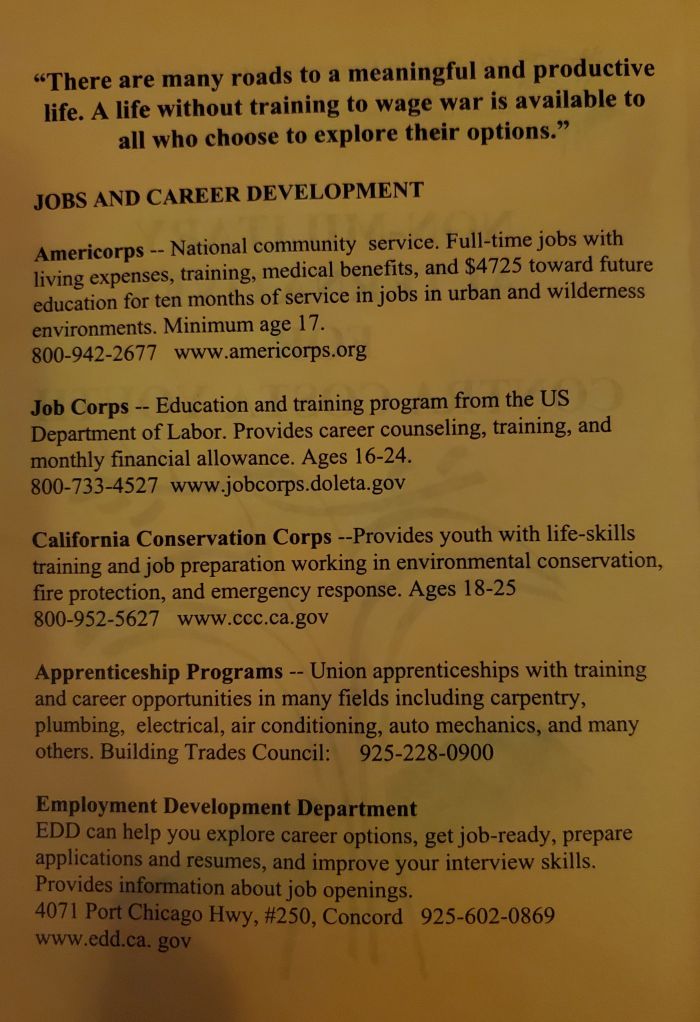
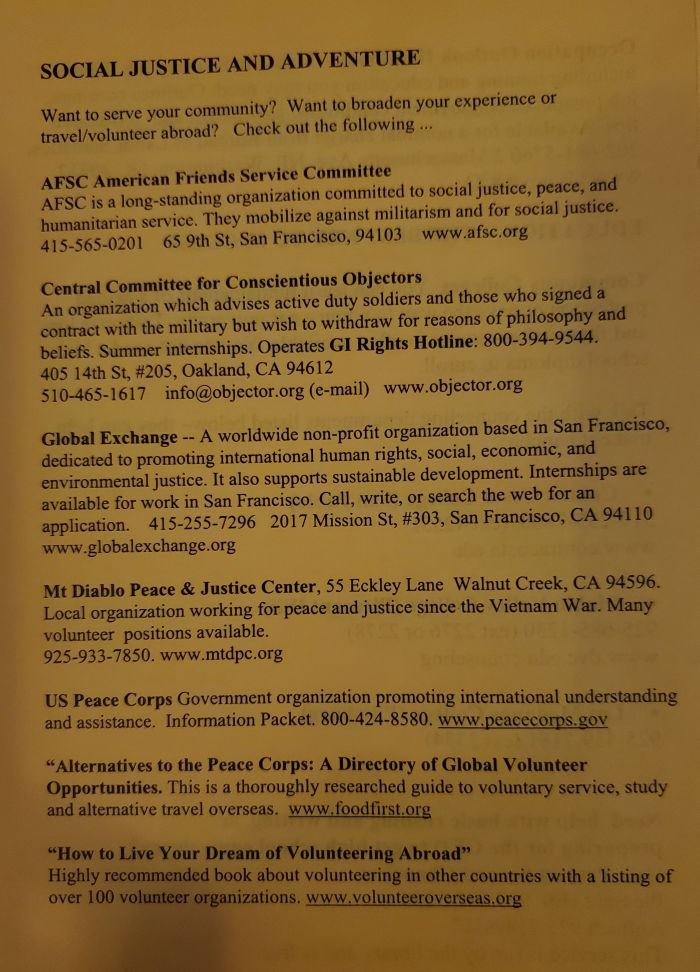
Alternatives to Military Service

Posted in jobs, justice, Labor, Military Alternatives | Tagged , , , , | Leave a comment

LEE CAMP: NINETEEN FACTS ABOUT AMERICAN POLICING THAT WILL BLOW YOUR MIND 2020-06-01

Just a few facts will change everything you think you know about American police!

With all the protests and anger and violence across the country, a justified discussion about policing has begun on our corporate media airwaves. (I would say the discussion is overdue, but in fact we’ve had it roughly every three years for the past 40 years.) However, despite all the coverage, a deeper debate sits ignored – A debate about why our American police system exists at all, how it works (or doesn’t), and where it came from.

The following 19 facts about American policing will change everything you think you know. First let’s start with the sheer amount of murder.

Read full article

Posted in police brutality, police reform | Tagged , , , | Leave a comment

Trump 2019 Impeachment – Ralph Nader Proposal

November 22, 2019 Letter to Nancy Pelosi

On November 22, 2019, Ralph Nader, Louis Fisher, Bruce Fein wrote to House Speaker Nancy Pelosi urging her to act on their proposed 12 Articles of Impeachment.

Both the letter and the Articles of Impeachment can be seen below.

300 New Jersey Avenue, N.W.
Suite 900
Washington, D.C. 20001
202-465-8728

November 22, 2019
The Speaker of the House of Representatives
United States Capitol
Washington, D.C. 20515

Dear Madam Speaker Pelosi:

On October 31, 2019, you elaborated with perfect pitch that the impeachment inquiry into President Donald Trump was not only about the man but about the constitutional oath of every Member of Congress to protect and defend the Constitution of the United States.

Among other things, you correctly underscored the danger of a Chief Executive who boasts, “Then I have Article II, where I have the right to do whatever I want as president.”

He has recklessly flirted with the ideas of slaughtering 10 million civilian Afghans, which, if acted upon, would violate the War Crimes Act, and initiating a nuclear war of aggression against North Korea, which, if acted upon, would violate the Declare War Clause.

A clear and present danger that the President will subvert the Constitution should trigger impeachment. Indeed, at the constitutional convention George Mason insisted that attempts to subvert the Constitution should be impeachable.

Uniquely among wayward presidents, Mr. Trump is shattering our entire constitutional order as our proposed twelve (12) count Article of Impeachment documents . (See enclosure).

Several of the counts are per se impeachable and need no more fact-finding:

defiance of congressional subpoenas and oversight;

spending billions of dollars on a southern border wall not appropriated for that purpose;

continuing or expanding presidential wars not declared by Congress;

exercising line-item veto power;

flouting the Emoluments Clause;

and, playing prosecutor, judge, jury, and executioner to kill any person on the planet based on secret, unsubstantiated information.

Hearings to educate the public about the alarming consequences of such per se violations is imperative to fortify the full constitutional legitimacy of the impeachment charges.

The Trump administration’s constitutional lawlessness is unprecedented. The defense of “everyone does it” will not wash. What Supreme Court Justice Louis D. Brandeis said about government lawlessness applies with special force to a President of the United States who should be a role model for the citizenry.

“In a government of laws, existence of the government will be imperiled if it fails to observe the law scrupulously. Our government is the potent, the omnipresent teacher. For good or for ill, it teaches the whole people by its example. Crime is contagious. If the government becomes a lawbreaker, it breeds contempt for law; it invites every man to become a law unto himself; it invites anarchy.”

The House impeachment inquiry into President Trump should be commensurate with the frightening breadth of his constitutional lawlessness, including multiple obstructions of justice.

Narrowly focusing on the solicitation of bribery and an illegal foreign campaign contribution connected to Ukraine while leaving the vast number of other constitutional wrongs or usurpations unsanctioned would be disastrous for moving public opinion in favor of impeachment.

The unrebuked usurpations would set a precedent that would lie around like a loaded weapon ready for use by future occupants of the White House who claim limitless executive power except a Ukraine-type shakedown.

They would downgrade the quality of presidential candidates and lower public expectations of the presidency to alarming levels.
Moreover, Mr. Trump will repeatedly claim his other impeachable abuses are meritless.

Since a Democratic majority in the House did not act more broadly, he will denounce the accusations as lies and fake news.

In 1974, the House Judiciary Committee declined to vote an Article of Impeachment against President Richard Nixon for his secret , unconstitutional war against Cambodia never declared or directed by Congress. Thereafter, unconstitutional secret or overt presidential wars of varying scope and duration became epidemic notwithstanding the War Powers Resolution.

We acknowledge that several of President Trump’s impeachable offenses were perpetrated by his predecessors with impunity because of congressional dereliction or otherwise. But that is an unpersuasive argument for the current Congress to stay its hand. No President has a right to rely on congressional nonfeasance of its impeachment powers.

Moreover, no other President has taken such a massive wrecking ball to our entire constitutional edifice. It is not even close. If the Trump presidency is not repudiated by Congress, our posterity will inherit vassalage to a presidential monarch rather than citizenry in a Republic.

An analogy here is instructive. For decades, men sexually harassed, assaulted, or subjugated women with impunity. Then came the #MeToo Movement. What was formerly acceptable and not prosecuted became unacceptable and penalized. There is no male defense that social acquiescence in past sexual predation justifies immunity from current prosecution. Trump’s personal assaults on many women are, of course, per se, sui generis impeachable offenses.

The Republic is at an inflection point. Either the Constitution is saved by impeaching and removing its arsonist in the White House, or it is reduced to ashes by continued congressional endorsement, whether by omission or commission, of limitless executive power and the undoing of checks and balances.

We are further convinced that making the Constitution the battleground of the 2020 elections is not politically objectionable. The Constitution is our birth certificate . It transcends party affiliation. It finds expression in E Pluribus Unum . It is what makes us a nation – not a fragile assemblage of parochial communities.

Corporate fraud, polluted air and water, climate disruption, consumer and worker injuries, deficient hospitals, inadequate mass transit, unaffordable housing, unrepaired roads and unimproved schools are “kitchen table” necessities bludgeoned by his dismantling of agencies established by Congress in violation of his constitutional duty to take care that the laws be faithfully executed, Article II, section 3.
Mr. Trump’s unconstitutional, multi-trillion-dollar garrison state featuring perpetual presidential wars jeopardizes them all.

With far more grave offenses regularly perpetrated than the offenses investigated in the Watergate hearings, the proposed twelve-count Article of Impeachment would invite absorbing televised congressional hearings to educate and unify the public behind our democracy, our hallowed constitutional order, and the urgency of impeaching its vandal-in-chief.

There can be no superior legacy for a House Speaker.
We would be eager to elaborate more broadly and deeply on this letter at your convenience.

Sincerely,
Ralph Nader, Esq. Louis Fisher* Bruce Fein, Esq.

*Louis Fisher was formerly a constitutional scholar for four decades, serving thirty-five years with Congressional Research Service and five years with the Law Library of Congress.

ARTICLE OF IMPEACHMENT RESOLVED – NOVEMBER 22, 2019

That Donald J. Trump, President of the United States, is impeached for bribery and high crimes and misdemeanors in violation of his constitutional oath of office and that the following article of impeachment be exhibited to the Senate:
ARTICLE OF IMPEACHMENT EXHIBITED BY THE HOUSE OF REPRESENTATIVES OF THE UNITED STATES OF AMERICA AND OF ALL THE PEOPLE OF THE UNITED STATES OF AMERICA, AGAINST DONALD J. TRUMP, PRESIDENT OF THE UNITED STATES OF AMERICA, IN MAINTENANCE AND SUPPORT OF ITS IMPEACHMENT AGAINST HIM FOR BRIBERY AND HIGH CRIMES AND MISDEMEANORS IN VIOLATION OF HIS CONSTITUTIONAL OATH OF OFFICE TO PRESERVE, PROTECT AND DEFEND THE CONSTITUTION OF THE UNITED STATES.
Article 1
In his conduct of the office of President of the United States, Donald J. Trump, in violation of his constitutional duty faithfully to execute the office of the President of the United States, and, to the best of his ability, preserve, protect and defend the Constitution of the United States, Article 1, section 1, clause 6, and, contrary to his public trust, has systematically scorned the letter and spirit of the Constitution on a scale vastly beyond any previous occupant of the White House in doing the following:

CONTEMPT OF CONGRESS. President Trump has notoriously boasted, “Then I have Article II, where I have the right to do whatever I want as President.” He has chronically acted in violation the Constitution accordingly.
The informing or oversight powers of Congress are even more important than its legislative prerogatives. The United States Supreme Court has repeatedly affirmed the plenary authority of Congress to investigate the executive branch for abuses, irregularities, illegalities or the need for new laws. Supreme Court Justice Louis D. Brandeis famously lectured, sunshine is said to be the best of disinfectants; electric light the most efficient policeman. The House Judiciary Committee voted an article of impeachment against President Richard M. Nixon for defying a congressional subpoena that compromised the ability of Congress to investigate impeachable offenses.
President Trump has repeatedly and unconstitutionally systematically undermined the congressional oversight power, including the ongoing congressional impeachment inquiry of the President himself, by instructing numerous current and former White House staff and members of the executive branch to defy congressional subpoenas on an unprecedented scale far beyond any previous President. Without congressional authority, he has secretly deployed special forces abroad and employed secret guidelines for targeted killings, including American citizens, based on secret unsubstantiated information. He has unconstitutionally endeavored to block private persons or entities from responding to congressional requests or subpoenas for information, e.g., Deutsche Bank. He has refused to provide Congress information about nepotistic or other security clearances he granted in opposition to his own FBI security experts. He has refused to disclose his tax returns to the Chairman of the Ways and Means Committee contrary to a 1924 law, 26 U.S.C. 6103 (f).
The informing or oversight powers of Congress are even more bedrock than legislation. Without information, Congress cannot enact informed legislative bills, repeal inadequate laws, or prevent maladministration of good ones. The Supreme Court of the United States has repeatedly affirmed the authority of Congress to investigate the executive branch for abuses, irregularities, illegalities or the need for new laws. Transparency, not secrecy, is the coin of the realm.
Congress possesses plenary authority independent of the federal judiciary to determine whether presidential defiance or obstruction of a congressional subpoena warrants impeachment for destroying the rule of law in favor of raw presidential power. A court order is unnecessary. Under the Constitution, the Supreme Court held impeachment questions are assigned to the House and Senate to the exclusion of federal courts in Nixon v. United States, 506 U.S. 224 (1993).

ABUSE OF THE POWERS OF THE PRESIDENT AND ABUSE OF PUBLIC TRUST. President Abraham Lincoln famously declared that, “A house divided against itself cannot stand.” The nation’s motto is E Pluribus Unum. President Trump, however, has fostered combustible division and rancor among “We the people of the United States” by inciting violence and threatening civil war if removed from office. Unlike prior presidents, he has made presidential lies as routine as the rising and setting of the sun, confounding civil discourse, truth and public trust. He has disrespected, belittled, and serially preyed upon women, mocked the disabled, incited violence against the mainstream media and critics, and encouraged and displayed bigotry towards minorities and minority Members of Congress, including intercession with Israel in serious violation of the Speech or Debate Clause, Article I, section 6, clause 1, to deny two Members visitor visas.
Mr. Trump has failed to superintend or check the chronic lawlessness of his subordinates, a dereliction of duty which James Madison characterized as an impeachable offense. In the very first Congress, Mr. Madison elaborated:
“I think it absolutely necessary that the President should have the power of removing his subordinates from office; it will make him, in a peculiar manner, responsible for their conduct, and subject him to impeachment himself, if he suffers them to perpetrate with impunity high crimes or misdemeanors against the United States, or neglects to superintend their conduct, so as to check their excesses.”
George Washington when presiding over the constitutional convention instructed, “Let us raise a standard to which the wise and honest can repair.” Mr. Trump has so disrespected that standard.
No other President has so consistently voiced extremist and inflammatory views across the board and so grossly neglected the duties of the Oval Office.

APPROPRIATIONS CLAUSE, REVENUE CLAUSE. Article I, section 9, clause 7 prohibits federal government expenditures “but in consequence of appropriations made by law.” Congress has consistently voted much less money than President Trump requested to build an extensive, multi-billion-dollar wall with Mexico. In violation of the Clause and the criminal prohibition of the Anti-Deficiency Act, President Trump has committed to spending billions of dollars far in excess of what Congress has appropriated for the wall. The congressional power of the purse is a cornerstone of the Constitution’s separation of powers. James Madison in Federalist 58 explained, “This power over the purse may…be regarded as the most complete and effectual weapon with which any constitution can arm the immediate representatives of the people, for obtaining redress of every grievance, and to carrying into effect every just and salutary measure.”
Article I, section 7, clause 1 requires all revenue measures to originate in the House of Representatives. In violation of the Clause, President Trump has raised tens of billions of dollars by unilaterally imposing tariffs with limitless discretion under section 232 of the Trade Expansion Act of 1962. He has become a Foreign Trade Czar in imposing tariffs or quotas or granting exemptions from his trade restrictions in his unbridled discretion to assist political friends and punish political enemies. Literally trillions of dollars in international trade have been affected. Riches are made and livelihoods destroyed overnight with the capricious stroke of President Trump’s pen.

EMOLUMENTS CLAUSE. Article I, section 9, clause 8 prohibits the President (and other federal officers), without the consent of Congress, from accepting any “present, emolument, office, or title, of any kind whatsoever, from any King, Prince, or foreign state.” The President should be above suspicion. The clause aims to prohibit dual loyalties or its appearance because of financial conflicts of interests. President Trump has notoriously refused to place his assets in a blind trust. Instead, he continues to profit from opulent hotels heavily patronized by foreign governments. He has permitted his family to commercialize the White House. He has compromised the national interest to enrich family wealth on a scale unprecedented in the history of the presidency.

TREATY CLAUSE. Article II, section 2, clause 2 requires Senate ratification of treaties by two-thirds majorities. The text is silent as to whether treaty termination requires Senate ratification, and the Supreme Court held the issue was a nonjusticiable political question in Goldwater v. Carter, 444 S. 996 (1979). But the Treaty Clause purpose indicates Senate approval of treaty terminations. Alexander Hamilton explained in Federalist 75 that the President would be an untrustworthy steward of the national interest in the conduct of international affairs because of the enormous temptation to betray the country to advance personal ambitions. That suspicion of presidential motives is equally implicated in treaty terminations and points to requiring Senate ratification. President Trump flouted the Treaty Clause in terminating the Intermediate-Range Nuclear Forces Treaty (INF) with Russia unilaterally. The treaty assigned the termination decision to the “United States.” The President alone is not the United States under the Treaty Clause.

DECLARE WAR CLAUSE. Article I, section 8, clause 11 empowers Congress alone to take the nation from a state of peace to a state of war. That power is non-delegable. The Declare War Clause authors distrusted the President to preserve the peace because of the temptation to war to aggrandize executive power and earn a place in history. In violation of the Declare War Clause, President Trump has continued to wage or has initiated presidential wars in Libya, Somalia, Yemen, Syria, Iraq, Afghanistan, and Pakistan, and has used special forces offensively in several African nations. President Trump has claimed authority to initiate war against any nation or non-state actor in the world—not in self-defense-on his say-so alone, including war against North Korea, Iran, or Venezuela.

TAKE CARE CLAUSE; PRESENTMENT CLAUSE. Article II, section 3 obligates the President to “take care that the laws be faithfully executed.” In violation of that trust, President Donald J. Trump deliberately attempted to frustrate special counsel Robert Mueller’s investigation of collaboration between the Trump 2016 campaign and Russia to influence the presidential election. Among other things, the President refused to answer specific questions relating to his presidential conduct; endeavored to fire the special counsel; dangled pardons for non-cooperating witnesses; and, urged Attorney General Jeff Sessions to reverse his recusal decision to better protect his presidency. In all these respects, the President was attempting to obstruct justice.
President Trump has also systematically declined to enforce statutory mandates of Congress by arbitrarily and capriciously revoking scores of agency rules ranging from immigration to the Consumer Financial Protection Board to the Environmental Protection Agency in violation of the Administrative Procedure Act or otherwise. He has routinely legislated by executive order in lieu of following constitutionally prescribed processes for legislation.
In violation of his constitutional duty to take care that the laws be faithfully executed, Mr. Trump has dismantled and disabled scores of preventive measures to save lives, avoid injuries or disease, help families, consumers, and workers, and detect, deter, and punish tens of billions of dollars of corporate fraud. He has disputed climate disruption as a “Chinese hoax,” compounded the climate crisis by overt actions that expand greenhouse gas emissions and pollution, and excluded or marginalized the influence of civil service scientists.
Article I, section 7, clause 2, as President George Washington explained, requires the President either to sign or veto a bill passed by Congress in toto. The President may not exercise a line-item veto, as the United States Supreme Court held in Clinton v. New York, 524 U.S. 417 (1998). President Trump, however, like several of his predecessors commonly exercises the equivalent of unconstitutional line-item vetoes through signing statements declaring his intent to leave unexecuted provisions he decrees are unconstitutional without a court test. Presidential signing statements weaken legislative power by disarming Congress from bundling in a single bill provisions both liked and disliked by the President and forcing the White House to choose between all or none. During the administration of President George W. Bush, an American Bar Association Task Force issued a report condemning signing statements as unconstitutional sent to the President himself. ABA Task Force on Presidential Signing Statements and the Separation of Powers Doctrine, August 2006.

DUE PROCESS CLAUSE. The Fifth Amendment provides that no person shall “be deprived of life…without due process of law.” In violation of due process, President Trump claims power, like his immediate two predecessors, to act as prosecutor, judge, jury, and executioner to kill American citizens or non-citizens alike, on or off a battlefield, whether or not engaged in hostilities, whether or not accused of crime, and whether or not posing an imminent threat of harm that would trigger a right of preemptive self-defense. This combination of powers are euphemistically referenced as “targeted killings,” but they define tyranny.

APPOINTMENTS CLAUSE. President Trump has repeatedly appointed principal officers of the United States, including the National Security Advisor and Cabinet officials, who have not been confirmed by the Senate in violation of the Appointments Clause, Article II, section 2, clause 2. On a scale never practiced by prior presidents, Mr. Trump has filled as many as half of Cabinet posts with “Acting Secretaries” who have never been confirmed by the Senate.

SOLICITING A FOREIGN CONTRIBUTION FOR THE 202O PRESIDENTIAL CAMPAIGN AND BRIBERY. President Trump has endeavored to corrupt the 2020 presidential campaign by soliciting the President of Ukraine to contribute something of value to diminish the popularity of potential rival Joe Biden, i.e., a Ukrainian investigation of Mr. Biden and his son Hunter relating to potential corrupt practices of Burisma, which compensated Hunter handsomely ($50,000 per month). In so doing, Mr. Trump violated the criminal campaign finance prohibition set forth in 52 U.S.C. 30121.
President Trump solicited a bribe for himself in violation of 18 U.S.C. 201 in seeking something of personal value, i.e., discrediting Joe Biden’s 2020 presidential campaign with the help of the President of Ukraine to influence Mr. Trump’s official decision to release approximately $400 million in military and related assistance.

VIOLATING CITIZEN PRIVACY. The Fourth Amendment protects the right to be let alone from government snooping, the most cherished right among civilized people as Justice Brandeis elaborated in Olmstead v. United States, 277 U.W. 438 (1928) (dissenting opinion). Government spying on Americans ordinarily requires a warrant issued by a neutral magistrate based on probable cause to believe crime is afoot. President Trump, however, routinely violates the Fourth Amendment with suspicionless surveillance of Americans for non-criminal, foreign intelligence purposes under Executive Order 12333 and aggressive interpretations of the Foreign Intelligence Surveillance Act.

SUPPRESSION OF FREE SPEECH. The major purpose of a free press protected by the First Amendment is to expose government lies or illegalities—to shine light on the dark side. Justice Hugo Black elaborated in New York Times v. United States, 403 US. 713 (1971) in protecting publication of the classified Pentagon Papers from suppression:
“The Government’s power to censor the press was abolished so that the press would remain forever free to censure the Government. The press was protected so that it could bare the secrets of government and inform the people. Only a free and unrestrained press can effectively expose deception in government. And paramount among the responsibilities of a free press is the duty to prevent any part of the government from deceiving the people and sending them off to distant lands to die of foreign fevers and foreign shot and shell.”
President Trump is violating the First Amendment in stretching the Espionage Act to prosecute publication of leaked classified information that are instrumental to exposing government lies and deterring government wrongdoing or misadventures, including the outstanding indictment against Julian Assange for publishing information which was republished by the New York Times and The Washington Post with impunity. The United States Supreme Court upheld the First Amendment rights of the New York Times and The Washington Post to publish the classified Pentagon Papers, which accelerated the conclusion of the disastrous Vietnam War, in New York Times v. United States.
In all of this, Donald J. Trump, since the day of his inauguration, has conducted the office of the President contrary to his oath of office to destroy constitutional government to the great prejudice of the cause of law and justice and to the manifest injury of the people of the United States.

Wherefore Donald J. Trump warrants impeachment and trial, and removal from office.

Source: Nader and Constitutional Scholars Push for 12 Articles of Impeachment

Ralph Nader on Impeachment: Democrats Should Go After Trump’s Full Corruption, Not Just Ukraine

.

Our Emergency

.

Specific Issues Index

From Creating Better World

.

Special Note: If one of my website links is bad, click Current Bad Website Links Detours to find a new link that should work!

Posted in Donald Trump Impeachment, Ralph Nader, Trump | Tagged , , , , , | Leave a comment

Abraham ( – 2000) and Jean Zwickel ( – 2005)

On Friday, August 26, 2005, on or around 4:20 in the morning,
in Antioch, California, my mother, Jean Cameron Wiley Zwickel
joined her beloved Abe on that Final Adventure. Jean wrote a book on the voices of Puerto Rico Independence movement “Voices for Independence”.

My father and mother, Abraham and Jean Zwickel brought their ideals, including pacifism, to their relationship when they met in 1943. My mother was living in an interracial, pacifist Christian commune in New York City called the Harlem Ashram. My father Abe, who already knew the founder of the Ashram, Jay Holmes Smith, had heard that they were planning a walk from New York to Washington to protest the Jim Crow laws which legalized segregation. Living in Baltimore at the time, he joined them en route and there the two met.

Father was that great rarity – both a conscientious objector and a Jew, at the time of WWII besides! Mother, from a Unitarian family and strongly influenced by the New York City Unitarian minister, John Haynes Holmes, held a similar pacifist philosophy and had in fact lost a teaching job for refusing to aid in enlisting young men in the military to fight the Germans. Father worked in a Quaker fire-fighting camp and ultimately served in prison for refusing to cooperate with the military. That was but the first of a lifelong series of arrests in the cause of peace and social justice. Read more

Abuela Jean

Voices for Independence/Voces pro Independencia

Abraham and Jean – In Celebration of their Life & Times

Posted in In Memorial | Tagged , , , , , , , , | Leave a comment